
Child Growth and Development Specialist in Jabalpur care focuses on understanding how a child grows physically, develops communication and learning skills, builds emotional and social abilities, and progresses through age-appropriate developmental milestones. Growth is not limited to height and weight. A child’s brain development, speech, language, movement, behaviour, social interaction, nutrition, sleep, and emotional well-being are also important parts of healthy development.
Every child develops at an individual pace, but there are broad developmental milestones that pediatricians use to understand whether a child is progressing as expected. Regular assessment can help identify concerns early and guide parents about nutrition, stimulation, daily routines, vaccinations, learning, behaviour, and other aspects of childhood health.
Dr. Reema Agrawal is the Director of Pediatrics at Infinity Heart Institute, Jabalpur. She completed her MBBS from Dr. Bhimrao Ambedkar University and MD in Pediatrics from IMS, BHU, Varanasi. Her professional experience includes work at IPGME&R-SSKM Hospital, and her areas of pediatric care include newborn care, child development, vaccination, pediatric emergencies, nutrition, and growth monitoring.
What Is Child Growth and Development?
Child growth refers mainly to measurable physical changes such as height, weight, head circumference in younger children, and body proportions. Development refers to the acquisition of abilities such as sitting, walking, speaking, understanding language, interacting with others, solving simple problems, and becoming increasingly independent.
A Pediatrician in Jabalpur may look at both growth and development during routine pediatric visits. A child can have normal height and weight while experiencing a speech, language, behavioural, social, or motor delay. Similarly, a child may have a nutritional or growth concern even when developmental skills appear appropriate.
This is why monitoring should consider the child as a whole rather than focusing on one measurement.
Why Is Growth and Development Monitoring Important?
Growth and development monitoring provides an opportunity to observe a child over time rather than evaluating development from a single visit. Height, weight, growth patterns, developmental skills, nutrition, sleep, behaviour, and physical health can be reviewed at appropriate intervals.
A Child Specialist in Jabalpur may compare measurements and developmental progress with age-appropriate expectations and the child’s previous records. The purpose is not to compare one child with another but to identify patterns that may require closer observation.
Regular monitoring can help parents understand whether a child is progressing appropriately and whether additional assessment may be useful.
What Are the Major Areas of Child Development?
Child development generally includes several interconnected areas. These include gross motor development, fine motor development, language and communication, cognitive development, social interaction, and emotional development.
Gross motor skills involve larger body movements such as sitting, standing, walking, running, jumping, and climbing. Fine motor skills involve smaller movements such as holding objects, drawing, feeding, buttoning clothes, and using age-appropriate tools.
Language development includes understanding words, making sounds, speaking, communicating needs, and gradually developing more complex language. Social and emotional development involves forming relationships, expressing emotions, responding to others, playing with peers, and developing independence.
What Is Growth Monitoring in Jabalpur?
Growth Monitoring in Jabalpur involves regularly assessing a child’s physical growth and looking at changes over time. Common measurements include weight and height or length, while head circumference is particularly important during infancy and early childhood.
Growth charts can help healthcare professionals understand whether a child is following an expected growth pattern. A single measurement usually does not provide the complete picture. The pattern across multiple measurements is often more informative.
Parents should also mention changes in appetite, eating behaviour, activity level, sleep, bowel habits, recurrent illnesses, or other concerns during pediatric visits.
How Do Children Develop During the First Year?
The first year involves rapid physical and neurological development. Babies gradually gain control over their head and body, learn to interact with caregivers, respond to sounds and faces, and develop increasingly purposeful movements.
During the early months, parents may notice social smiles, cooing, recognition of familiar voices, improved head control, reaching for objects, rolling, sitting, and eventually crawling or moving independently.
A Child Development Specialist in Jabalpur can help parents understand that developmental milestones are ranges rather than exact deadlines. Some variation is normal, but a significant delay or loss of a previously acquired skill should be evaluated.
Development From One to Three Years
Between one and three years, children usually become increasingly mobile and independent. Walking develops into running, climbing, and more coordinated movements. Fine motor skills also improve as children begin using spoons, stacking objects, turning pages, scribbling, and participating in simple daily activities.
Language can progress from single words to short combinations and increasingly meaningful communication. Children also begin to understand simple instructions and develop stronger preferences.
A Pediatrician in Jabalpur can assess language, motor, social, and cognitive development while also reviewing nutrition, sleep, vaccinations, and general health during these years.
Development Between Three and Five Years
The preschool years bring significant changes in communication, social interaction, imagination, and problem-solving. Children may begin asking many questions, telling simple stories, identifying colours and shapes, following more complex instructions, and participating in group activities.
They gradually learn concepts such as sharing, taking turns, following rules, and managing emotions. Physical coordination also improves, allowing children to run, jump, draw, build, and perform more independent tasks.
A Child Specialist in Jabalpur can help parents understand expected skills for this age and identify areas where additional support or developmental evaluation may be appropriate.
What Are Developmental Milestones?
Developmental milestones are skills that most children achieve within particular age ranges. They provide a framework for observing development rather than serving as a strict examination that every child must pass on a specific date.
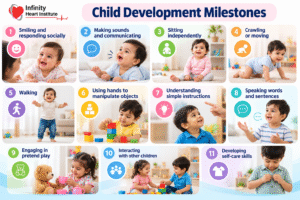
Milestones can include:
- Smiling and responding socially
- Making sounds and communicating
- Sitting independently
- Crawling or moving
- Walking
- Using hands to manipulate objects
- Understanding simple instructions
- Speaking words and sentences
- Engaging in pretend play
- Interacting with other children
- Developing self-care skills
Growth Monitoring in Jabalpur may therefore be combined with developmental observation so that physical growth and developmental progress are considered together.
What Is the Difference Between Growth and Development?
Growth is primarily quantitative. It can be measured through height, weight, head circumference, and other physical parameters.
Development is more qualitative and functional. It involves acquiring new skills and abilities in areas such as movement, communication, thinking, social interaction, and emotional regulation.
A child may be tall or have a healthy weight but still require assessment for speech delay. Another child may have appropriate developmental skills but have poor weight gain.
A Child Development Specialist in Jabalpur can help parents understand these differences and determine whether a particular concern requires observation, nutritional intervention, developmental assessment, or further investigation.
How Does Nutrition Affect Child Growth?
Nutrition provides the energy and nutrients required for physical growth, brain development, immune function, and everyday activity. Children need an age-appropriate balanced diet containing adequate protein, carbohydrates, healthy fats, vitamins, minerals, and fluids.
Poor nutrition may contribute to inadequate weight gain, nutritional deficiencies, fatigue, reduced concentration, or other concerns. Excessive intake of calorie-dense foods can also contribute to childhood overweight and obesity.
A Pediatric Nutritionist in Jabalpur can assess eating patterns, growth measurements, food preferences, nutritional requirements, and specific concerns such as picky eating, underweight, overweight, or suspected deficiencies.
What Should a Balanced Diet for Children Include?
The exact nutritional requirement varies according to age, growth pattern, activity, health status, and individual needs. A balanced diet generally includes a variety of foods rather than depending on one particular food group.
Depending on age, meals can include vegetables, fruits, pulses, whole grains, dairy or suitable alternatives, eggs, nuts or seeds where appropriate, and other sources of protein and healthy fats.
Parents should also pay attention to regular meal patterns and hydration. Excessive sugary drinks, highly processed snacks, and frequent fried foods can displace more nutritious options.
Pediatric Nutritionist in Jabalpur guidance can be particularly useful when parents are unsure whether a child’s diet is meeting nutritional requirements.
How Does Sleep Affect Child Development?
Sleep is an important part of childhood health and development. Children require more sleep than adults, and sleep needs change as they grow.
Adequate sleep supports physical recovery, learning, memory, attention, emotional regulation, and overall well-being. Irregular routines, excessive stimulation before bedtime, or other factors may interfere with healthy sleep.
Parents should discuss persistent snoring, frequent nighttime waking, difficulty falling asleep, unusual nighttime behaviour, or significant daytime sleepiness with a pediatrician.
A Pediatrician in Jabalpur can review sleep patterns alongside nutrition, development, behaviour, and general health when concerns arise.
What Role Does Play Have in Child Development?
Play is one of the natural ways children learn. Through play, children practise movement, language, problem-solving, imagination, communication, cooperation, and emotional expression.
Simple activities such as building blocks, drawing, storytelling, puzzles, outdoor games, pretend play, and age-appropriate household activities can support different developmental areas.
Young children do not necessarily need expensive toys. Talking with them, reading together, singing, exploring outdoors, and allowing safe independent play can provide valuable learning opportunities.
A Child Development Specialist in Jabalpur may also guide parents about age-appropriate activities when a child needs additional stimulation in a particular developmental area.
How Do Parents Support Language Development?
Parents can support language development through everyday communication. Talking to a child, responding to sounds and gestures, reading books, naming objects, singing songs, and encouraging conversation can create opportunities for language learning.
Instead of only asking children to repeat words, parents can describe what they are doing and respond to the child’s attempts to communicate.
For example, if a child points toward a ball, a parent can say, “You want the ball,” and then continue the interaction. Such simple exchanges can help children connect words with objects, actions, and emotions.
Child Development Specialist in Jabalpur assessment may be useful when parents notice limited vocabulary, difficulty understanding language, reduced communication, or other concerns about speech and language development.
What Are Signs of a Possible Developmental Delay?
Developmental delay can involve one or more areas, including movement, speech, language, learning, social interaction, or behaviour.
Parents may notice signs such as:
- Not responding to sounds or voices
- Limited eye contact
- Lack of expected communication
- Difficulty using age-appropriate words
- Delayed sitting, walking, or other motor skills
- Difficulty interacting with others
- Repetitive behaviours
- Difficulty following simple instructions
- Loss of previously acquired skills
A Child Specialist in Jabalpur can assess the child’s history and developmental pattern when concerns arise. Early assessment does not automatically mean that a child has a specific disorder. It provides an opportunity to understand the concern and determine whether further evaluation or support is needed.
Why Should Developmental Regression Be Taken Seriously?
Developmental regression means a child loses a skill that they had previously acquired. For example, a child who previously used certain words may stop using them, or a child who was walking may stop walking.
Regression should not simply be attributed to laziness or temporary changes without appropriate assessment.
Child Development Specialist in Jabalpur evaluation can help determine what has changed, when it started, whether other symptoms are present, and whether additional developmental or medical assessment is needed.
Parents should document noticeable changes and discuss them with a pediatrician rather than waiting for the problem to resolve on its own.
How Can Screen Time Affect Development?
Screens can become part of children’s daily lives through televisions, phones, tablets, computers, and other devices. The effect of screen use depends on factors such as the child’s age, amount of exposure, content, and whether screens replace sleep, physical activity, play, communication, or family interaction.
For younger children especially, direct interaction with caregivers and real-world play provide important opportunities for language, movement, and social development.
Parents can create screen routines appropriate for the child’s age and ensure that screen use does not consistently replace meals, sleep, outdoor activity, reading, conversation, or play.
A Pediatrician in Jabalpur can discuss screen habits along with sleep, behaviour, learning, and other developmental concerns.
How Important Is Emotional Development?
Physical growth is only one component of healthy childhood development. Children also need opportunities to develop emotional security, confidence, empathy, communication, and the ability to manage age-appropriate frustration.
Parents can support emotional development by maintaining predictable routines, listening to children, acknowledging feelings, setting consistent boundaries, and avoiding harsh or frightening responses.
Children learn emotional regulation partly by observing how adults respond to stress and difficult situations.
A Child Specialist in Jabalpur can help parents discuss behavioural or emotional concerns and determine whether additional support may be appropriate.
What Is the Role of Regular Pediatric Checkups?
Regular pediatric visits provide opportunities to assess growth, development, nutrition, vaccination status, sleep, behaviour, and general health. They also allow parents to raise questions that may not seem urgent but may become important over time.
Growth measurements are more useful when recorded consistently. Developmental observations can also be compared with earlier visits to identify progress or areas that need closer attention.
Growth Monitoring in Jabalpur can therefore become part of routine preventive pediatric care rather than something parents consider only when a child appears unwell.
How Can Growth Charts Help Parents?
Growth charts provide a visual way to track measurements such as height and weight over time. They help healthcare professionals identify whether a child’s growth is following a consistent pattern.
A measurement that appears high or low on its own does not necessarily indicate a health problem. Genetic factors, birth history, nutrition, illness, and many other factors can influence growth.
The trend across time is important. A sudden change in growth pattern may deserve further assessment.
A Pediatrician in Jabalpur can interpret growth measurements in the context of the child’s overall health rather than relying on one number alone.
What Can Cause Poor Growth in Children?
Poor growth can have many possible causes. These may include inadequate nutritional intake, feeding difficulties, recurrent illness, gastrointestinal problems, endocrine conditions, chronic diseases, genetic factors, or other medical concerns.
Some children may simply have a naturally smaller body size but continue to follow a healthy growth pattern. Others may show a change in their growth trajectory.
A Pediatric Nutritionist in Jabalpur can assess dietary intake and eating behaviour, while the pediatrician can determine whether medical evaluation is required.
What Can Parents Do for a Child Who Is a Picky Eater?
Picky eating is common during childhood, particularly when children begin developing stronger food preferences. Parents can offer a variety of nutritious foods without making every meal a conflict.
Helpful approaches can include:
- Offering small portions
- Repeatedly introducing new foods
- Eating together as a family
- Maintaining regular meal times
- Avoiding excessive snacking between meals
- Avoiding force-feeding
- Making meals calm and predictable
Persistent food refusal, poor weight gain, nutritional deficiency, difficulty swallowing, or other symptoms should be discussed with a pediatrician.
A Pediatric Nutritionist in Jabalpur can help identify whether the child’s food intake is adequate and suggest practical dietary strategies.
How Can Physical Activity Support Development?
Physical activity helps children develop strength, coordination, balance, endurance, and motor skills. Younger children naturally learn through movement, while older children benefit from active play, sports, cycling, walking, and other age-appropriate activities.
Outdoor play also provides opportunities for children to explore their surroundings, interact with others, and develop confidence.
The activity should be appropriate for the child’s age and physical ability. Children with specific medical conditions may require individualized advice.
Growth Monitoring in Jabalpur can include discussion of physical activity, especially when there are concerns about underweight, overweight, delayed motor skills, or reduced activity.
How Does School Readiness Relate to Development?
School readiness involves more than knowing letters and numbers. Children need communication skills, attention, social interaction, basic self-care abilities, emotional regulation, and the ability to follow simple instructions.
Parents can support readiness through reading, conversation, drawing, puzzles, storytelling, simple household responsibilities, and opportunities to play with other children.
A child who needs additional support in language, attention, behaviour, or social interaction may benefit from early evaluation rather than waiting until academic difficulties become significant.
A Child Development Specialist in Jabalpur can help parents understand developmental strengths and areas where support may be useful.
When Should Parents Seek a Developmental Assessment?
Parents should consider discussing concerns with a pediatrician when they notice a persistent difference between their child’s abilities and expected developmental skills, particularly when the concern affects communication, movement, social interaction, learning, behaviour, or daily functioning.
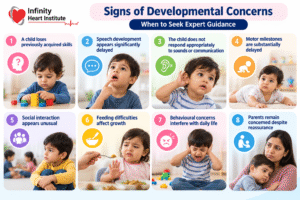
Assessment may also be appropriate when:
- A child loses previously acquired skills
- Speech development appears significantly delayed
- The child does not respond appropriately to sounds or communication
- Motor milestones are substantially delayed
- Social interaction appears unusual
- Feeding difficulties affect growth
- Behavioural concerns interfere with daily life
- Parents remain concerned despite reassurance
A Child Development Specialist in Jabalpur can review the child’s history, observe developmental skills, and determine whether additional evaluation is necessary.
How Can Autism Screening Help?
Autism spectrum disorder can affect communication, social interaction, behaviour, and sensory processing. Children may show differences in eye contact, response to their name, gestures, communication, social interaction, or repetitive behaviours.
Screening tools can help identify children who may benefit from further assessment. Screening is not the same as diagnosis.
Infinity Heart Institute lists screening for autism spectrum disorder among Dr. Reema Agrawal’s pediatric services.
If parents notice developmental concerns, discussing them early can help determine whether formal developmental assessment is appropriate.
How Does Vaccination Support Healthy Childhood?
Vaccination protects children against several serious infectious diseases. Keeping vaccinations up to date is an important component of preventive pediatric care.
Parents should maintain vaccination records and discuss routine and recommended vaccines with their pediatrician. Vaccination schedules can vary according to age, health circumstances, and national recommendations.
Dr. Reema Agrawal’s pediatric services include vaccination and immunization, alongside growth and development monitoring.
How Are Nutrition and Development Connected?
Nutrition and development are closely connected because children require adequate energy and nutrients for growth, brain function, immunity, and physical activity.
Long-term nutritional problems may affect weight gain and overall health, while certain deficiencies may contribute to fatigue or other symptoms.
However, supplements should not automatically be given simply because a child is a picky eater. Nutritional assessment can help determine whether dietary changes, testing, or supplementation is actually needed.
A Pediatric Nutritionist in Jabalpur can review the child’s diet alongside growth measurements and medical history to identify appropriate nutritional strategies.
About Dr. Reema Agrawal – Pediatrician at Infinity Heart Institute
Dr. Reema Agrawal is the Director of Pediatrics at Infinity Heart Institute, Jabalpur. According to the hospital’s published information, she completed her MBBS from Dr. Bhimrao Ambedkar University and MD in Pediatrics from IMS, BHU, Varanasi. Her experience includes work at IPGME&R-SSKM Hospital, and she focuses on newborn care, child development, vaccination, nutrition, and pediatric emergencies.
The hospital identifies Dr. Reema Agrawal as a pediatrician caring for newborns, infants, toddlers, school-age children, and adolescents. Her listed pediatric services include nutritional counselling, growth and development monitoring, autism spectrum disorder screening, child safety counselling and assessment, vaccination, newborn care, and pediatric conditions such as asthma and infections.
Her approach to developmental care involves looking at the child’s physical growth and broader developmental needs. For parents, this means that questions about height, weight, nutrition, speech, behaviour, learning, sleep, or milestones can be discussed as part of overall pediatric care.
What Can Parents Do Every Day to Support Healthy Development?
Parents do not need expensive equipment or complicated activities to support their child’s development. Everyday interactions provide many opportunities for learning.
Parents can:
- Talk to their child regularly
- Read age-appropriate books
- Encourage active play
- Provide nutritious meals
- Maintain predictable sleep routines
- Give children opportunities to explore safely
- Encourage age-appropriate independence
- Listen to their concerns
- Limit unnecessary screen exposure
- Encourage social interaction
- Attend regular health checkups
- Maintain vaccination records
A Child Specialist in Jabalpur can provide age-specific guidance when parents are uncertain about nutrition, sleep, behaviour, development, or physical growth.
Frequently Asked Questions About Child Growth and Development
1. What does child growth and development include?
Child growth includes physical measurements such as height and weight, while development includes movement, communication, language, thinking, social interaction, emotional skills, and increasing independence.
2. How often should my child’s growth be monitored?
The appropriate frequency depends on the child’s age, health, growth pattern, and individual needs. Routine pediatric visits provide opportunities to record measurements and discuss developmental progress.
3. What is Growth Monitoring in Jabalpur?
Growth Monitoring in Jabalpur involves regularly tracking a child’s physical growth, including measurements such as height and weight, and reviewing the pattern over time.
4. When should I consult a Child Development Specialist in Jabalpur?
A Child Development Specialist in Jabalpur may be consulted when parents notice concerns related to speech, language, movement, learning, behaviour, social interaction, or loss of previously acquired skills.
5. Can nutrition affect my child’s development?
Yes. Adequate nutrition supports physical growth, brain function, immunity, and everyday activity. Persistent nutritional problems may require assessment.
6. What does a Pediatric Nutritionist in Jabalpur do?
A Pediatric Nutritionist in Jabalpur can assess a child’s dietary intake, eating habits, growth pattern, nutritional requirements, and concerns such as picky eating, underweight, overweight, or suspected deficiencies.
7. What is a developmental milestone?
A developmental milestone is an age-associated skill that many children acquire during a particular developmental period. Milestones may involve movement, communication, language, social interaction, and cognitive skills.
8. Is every developmental delay a serious problem?
Not necessarily. Children develop at different rates, and some variations are normal. However, persistent delays or loss of previously acquired skills should be discussed with a pediatrician.
9. Why are regular pediatric checkups important?
Regular visits provide opportunities to monitor growth, development, nutrition, vaccination, sleep, behaviour, and general health and to identify concerns early.
10. Can a child have normal weight but still have a developmental concern?
Yes. Physical growth and developmental progress are related but not identical. A child can have appropriate height and weight while needing evaluation for speech, language, behavioural, social, or motor concerns.
11. What is autism screening?
Autism screening uses standardized developmental questions or tools to identify children who may benefit from further evaluation. Screening itself does not establish a diagnosis.
12. How can parents support language development?
Talking, reading, singing, responding to communication attempts, naming objects, and engaging in face-to-face interaction can provide valuable opportunities for language development.
13. Does sleep affect child development?
Healthy sleep supports learning, memory, physical recovery, attention, and emotional regulation. Persistent sleep problems should be discussed with a pediatrician.
14. What should I do if my child loses a skill?
Loss of a previously acquired skill should be discussed with a pediatrician. A detailed developmental assessment may help determine the next appropriate step.
15. Is picky eating always a nutritional problem?
Not always. Picky eating is common in childhood. However, persistent food refusal, poor growth, nutritional deficiency, swallowing difficulties, or other symptoms may require professional assessment.
16. What is the role of play in development?
Play allows children to practise movement, communication, problem-solving, imagination, social interaction, and emotional skills. Age-appropriate play can support multiple areas of development.
17. Why is growth chart tracking important?
Growth charts help healthcare professionals observe patterns in height and weight over time. The overall trend is generally more useful than interpreting one isolated measurement.
18. When should parents be concerned about speech development?
Parents should discuss concerns when a child appears significantly behind expected communication skills, has difficulty understanding language, has limited communication, or loses previously acquired language skills.
19. Can screen time replace developmental activities?
Screens should not consistently replace sleep, physical activity, reading, conversation, social interaction, or hands-on play. Age-appropriate screen habits should be discussed with a pediatrician when concerns arise.
20. Where can parents discuss growth and developmental concerns?
Parents can discuss concerns with their pediatrician, who can assess the child’s growth, developmental milestones, nutrition, behaviour, and overall health and determine whether further evaluation is needed.
Conclusion – Supporting Healthy Child Growth and Development
Healthy growth and development involve much more than increasing height and weight. Children also need opportunities to develop communication, movement, learning, social interaction, emotional regulation, independence, and healthy eating and sleeping habits.
Regular monitoring can help parents understand their child’s progress and identify concerns early. Nutrition, vaccination, physical activity, sleep, play, communication, and a supportive home environment all contribute to a child’s overall development.
At Infinity Heart Institute, Dr. Reema Agrawal provides pediatric care covering newborn and infant care, vaccination, nutrition, growth and development monitoring, developmental concerns, autism screening, and pediatric emergencies.
For parents seeking a Child Growth and Development Specialist in Jabalpur, the focus should be on understanding the individual child’s growth pattern, developmental skills, nutritional needs, and overall health. Early discussion of concerns can help families understand what is expected, what may simply require observation, and when further assessment or support may be appropriate.